⏱ 4 min read
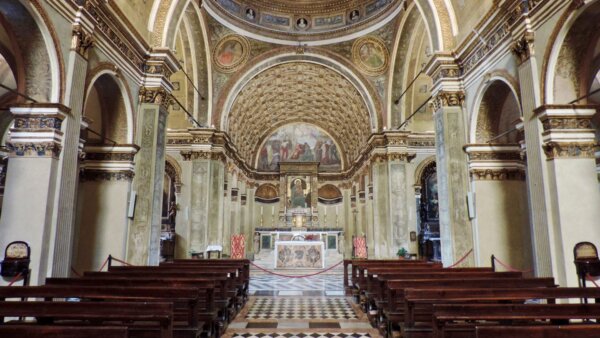
The ancient Basilica of Sant’Eustorgio in Milan is one of those places that capture everyone’s imagination. Guide’s honour!
Beyond its antiquity, the basilica also serves as a treasured repository of the Magi’s relics.
To signal this important presence, a star was placed atop its ancient bell tower (instead of the traditional cross), alluding to the comet the Three Kings followed.
To honor the relics of the Magi, a historic procession has been held on January 6th, the day of the Epiphany, since 1336. Three volunteers, dressed as the Magi, lead the procession. It carries the faithful (and curious passers-by) from the Milan Cathedral to the Basilica of Sant’Eustorgio.
Why are the Magi’s relics here?
It is said that in the 4th century AD, Eustorgius I, once elected bishop of Milan, was invited to Constantinople to meet Emperor Constans. Constans possessed the sacred relics of the three Magi, which Queen Helena (mother of Emperor Constantine) had brought to Constantinople. He decided to donate them to Eustorgius. Eustorgius accepted and made the long journey home aboard a heavy ox-drawn cart. The cart became stuck in the mud just outside Milan.
There, the bishop decided to build a basilica to house the sacred relics, which was named after him.
That ancient basilica was rebuilt several times, the most significant reconstruction following its destruction by Frederick Barbarossa in 1262. The bellicose Frederick also appropriated the Magi’s relics, which were taken to Cologne (Germany). Only in 1903 were some portions of those poor mortal remains returned to Milan, thanks to the diplomatic efforts of the city’s Bishop, Cardinal Ferrari. This means that for nearly 800 years, the procession was held to celebrate an empty reliquary.
The basilica became a Dominican convent in the 13th century. Almost simultaneously, it also became a court of the Inquisition until the 16th century. San Eustorgio was always highly regarded. Over the centuries, it received splendid funerary chapels from some of the city’s noble families. Inside, you can still admire masterpieces created by the finest artists who worked in Milan between the 14th and 15th centuries.
The true star of the basilica is the magnificent chapel commissioned by the Florentine Pigello Portinari. Built in the second half of the 15th century, it stands behind the church’s apse. Portinari was the “director” of the Medici Bank, a sort of bank founded in Milan through the friendship between the Duke of Milan, Francesco Sforza, and the Medici family of Florence. Unfortunately, we don’t know who designed the harmonious chapel, but Portinari undoubtedly had very refined taste. Anyone entering that part of Sant’Eustorgio is also captivated by the frescoes decorating the walls. The frescoes were painted by Vincenzo Foppa from Brescia, who overcame himself.
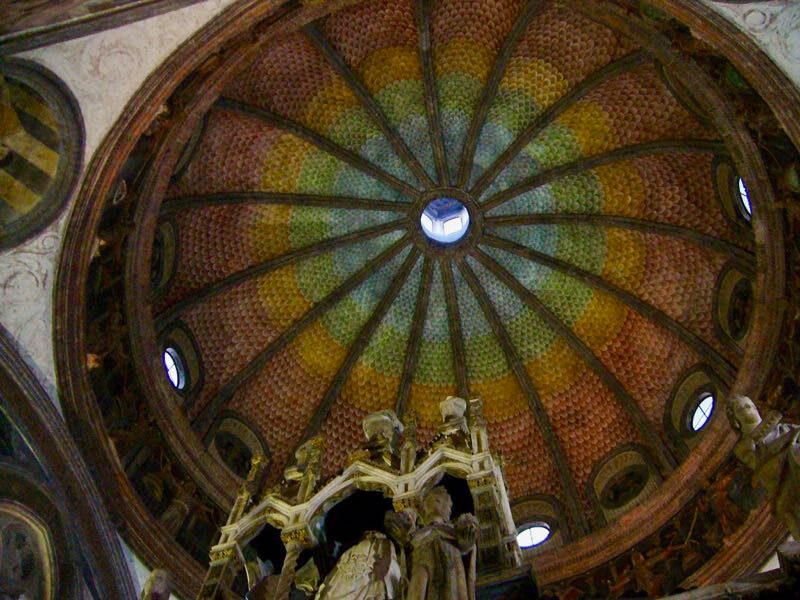
At the center of the aforementioned chapel is a superb funerary monument. It was sculpted in the 14th century by the Tuscan Giovanni di Balduccio. This is the tomb of a Dominican friar and preacher assassinated near Milan in 1252. His name was Pietro Rosini, known as ‘da Verona.’ He was killed by a blow to the head with an axe. Canonized a year after his death, he became the saint to pray to for headaches.
A final, macabre detail: Saint Peter of Verona’s head was removed after his death and is displayed separately only on his feast day, April 29th.