⏱ 3 min read
Every tour guide has a favorite spot they proudly show. Mine is along one of Milan’s busiest streets, and not all my fellow citizens know it exists.
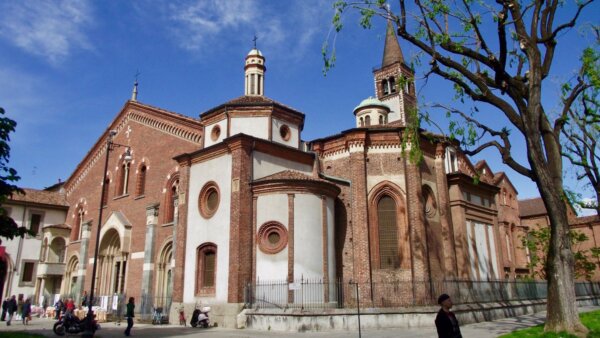
I’m referring to the small 15th-century church built to house a fresco depicting Mary and the infant Jesus.
The church also incorporates an ancient 9th-century shrine dedicated to Saint Satiro, the brother of Saint Ambrose.
This little church, Santa Maria presso San Satiro, is special in many ways.
It was built by one of our greatest architects, Donato “Donnino” di Angelo di Pascuccio, known as Bramante. Later in life, he designed St. Peter’s Basilica in Rome. This church was his first Milan project.
Bramante was born near Urbino, though his education remains unclear. He lived and taught in Milan for about 20 years, and his buildings remain innovative after six centuries. I believe if he were alive today, he’d be among the most cutting-edge architects.
The small church was commissioned by the Sforza family, the rulers of Milan. Construction began in 1478 to safeguard the venerated fresco of Mary with the infant Jesus. Almost two centuries earlier, the fresco had cried tears of blood when attacked by a thug.
The small church’s space is extremely harmonious. When one enters, one feels like being in a building much larger than it actually is. Our brilliant Bramante had to build the church using a space squeezed among the various houses of Milan. To create the apse, he devised an absolutely unique system, the likes of which no one had ever seen before (at least in Lombardy). Since there was no space, the apse was painted on the back wall of the church, above the fresco depicting Mary. The decoration, partly gilded stucco and partly painted using the fresco technique, measures approximately 90 cm (35 inches) and, seen from a distance, truly seems like a real space.
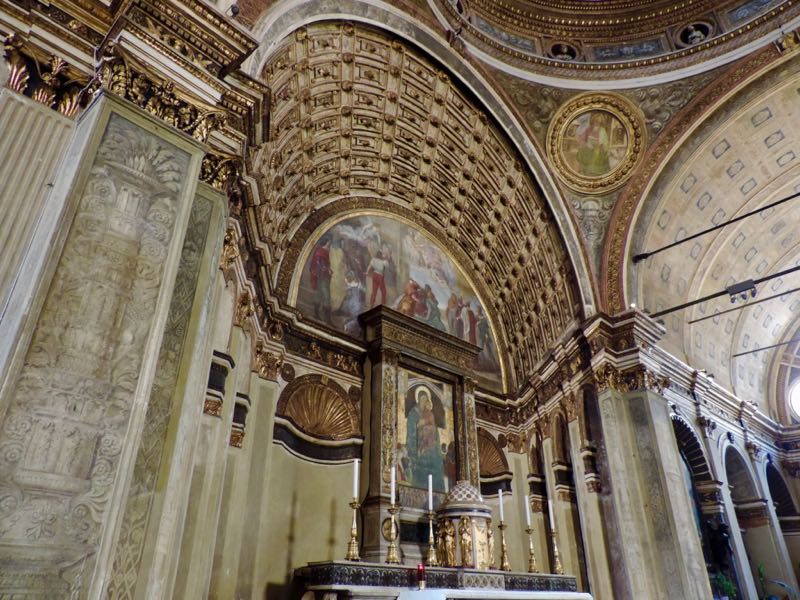
When my guests enter that church, they rub their eyes until they realize that what they see on the back wall is not a real space but an incredible optical illusion created by perspective painting. This is undoubtedly what makes Santa Maria Presso San Satiro unique.
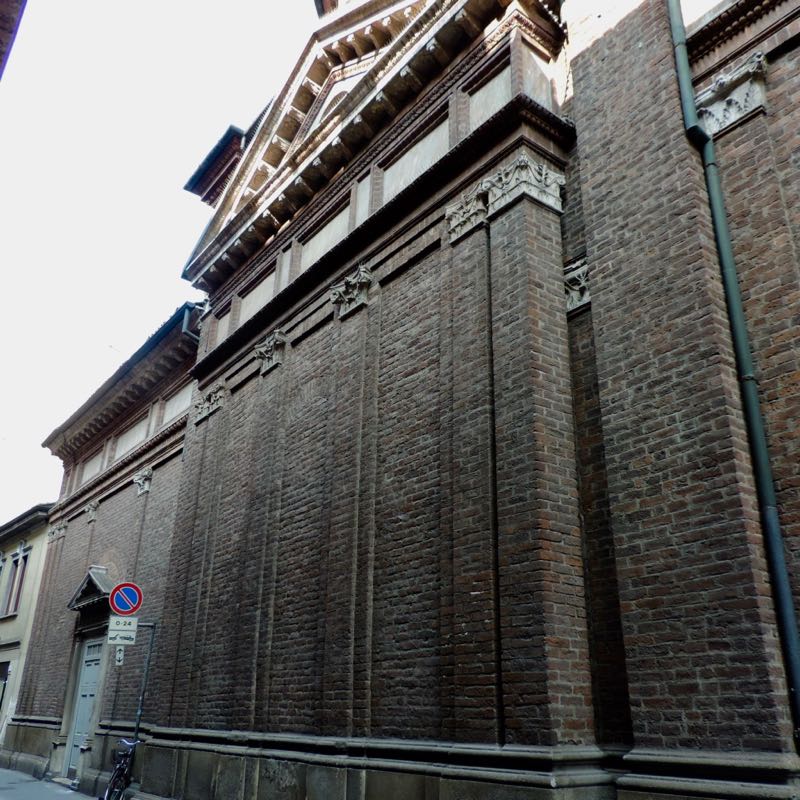
Bramante also remodeled the San Satiro chapel in Renaissance style. He added an octagonal building, now the baptistery, with terracotta sculptures by Agostino de Fondulis.
The bell tower is an ancient structure with an unusual feature: it incorporates part of a neighboring café. From the café’s upper floor, customers can step inside the bell tower and look into the church.